AI is already in your organization… whether you approved it or not.
AI didn’t arrive through a formal project plan or a budget request. It showed up quietly in everyday work; someone drafting an email faster, summarizing a long document, asking for help troubleshooting, or dropping a spreadsheet into an AI tool to “make sense of it”. In most businesses, this is happening right now, often on personal accounts, without visibility, policy, or guardrails.
This reminds us of the similarities with BYOD (Bring your Own Device) and its set of technical hurdles, and emphasizes why the question is no longer “Should we use AI?” The real question is: how do we use it intentionally and safely in a way that actually delivers results?
Public AI tools are powerful because they’re frictionless. But that convenience can create risk the moment company information leaves your control. A “harmless” paste can include customer names, pricing, internal notes, financials, HR data, network details, or vendor relationships. Even if it wasn’t meant to be sensitive, it may become sensitive the second it’s combined with other information or used to infer things you didn’t realize you were sharing. For Canadian organizations, that risk isn’t only technical. It’s legal and contractual too. Once data is processed by a platform controlled outside Canada, it can fall under foreign jurisdiction and disclosure regimes in ways that aren’t always obvious to the end user (CLOUD Act).
The instinctive response is often to ban AI. The problem is that bans rarely stop usage. They usually just push it underground. People still use the tools because the productivity boost is real, but now the organization has less visibility, less consistency, and no way to govern how information is being handled.
This is where private AI changes the equation.
Private AI isn’t about slowing innovation down. It’s about owning it. Instead of sending business data into a public platform, private AI allows organizations to keep control over where data goes, who can access it, and how it’s retained. You can apply identity controls, restrict what the system can see, log activity for auditability, and align usage with your legal obligations and client contracts. In short: you can say “yes” to AI without saying “yes” to uncontrolled risk.
But the real opportunity isn’t just “private AI chat.” The real opportunity is connecting AI to workflows so it delivers outcomes, not just answers.
When private AI is paired with automation tool enablers like n8n, it becomes a practical engine for everyday operations. Instead of asking a chatbot to help once in a while, you can build systems where AI reads incoming requests, summarizes and classifies them, routes them to the right place, creates tickets, drafts responses, updates your CRM, flags exceptions, and documents what it did — all with human oversight where it matters. This turns AI from an “assistant” into a consistent operational layer that reduces noise and accelerates decision-making.
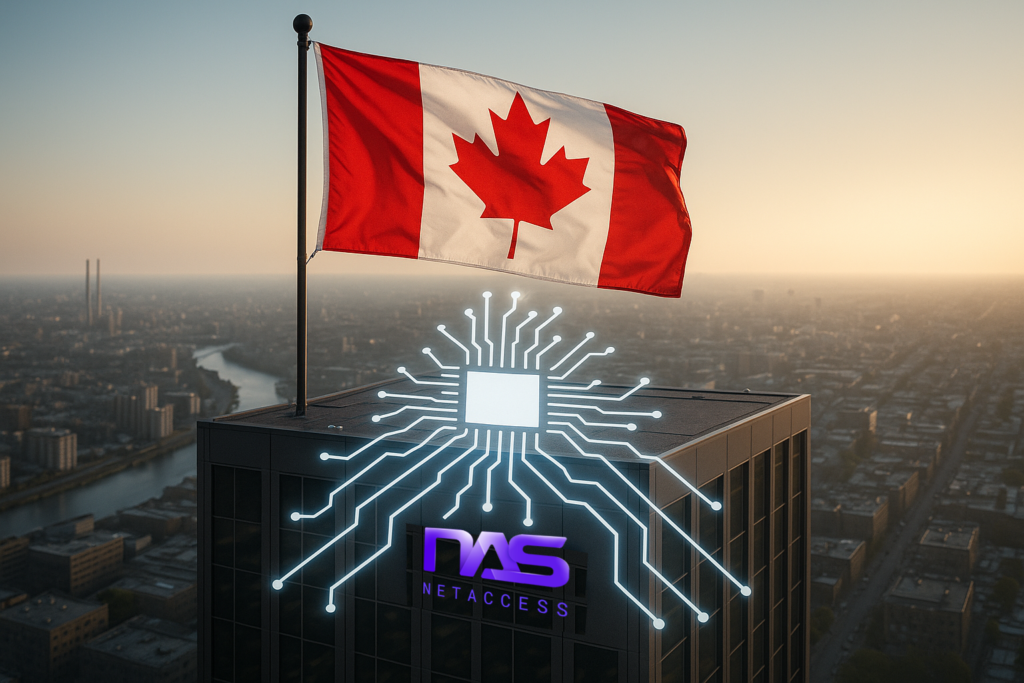
Hosting matters. Period. But so does the network path your data takes to get there. With private AI running in the NetAccess datacenter, organizations gain Canadian data residency and stronger governance, but also the option to connect headquarters and remote sites over private connectivity such as dedicated links, MPLS, or SD-WAN. That means sensitive data and AI workflows can stay on controlled private infrastructure end-to-end, rather than traversing the public internet. The result is better trust, clearer compliance alignment, and a confident answer when clients ask: “Where does our data go?”
This is how Canadian organizations turn AI into a competitive advantage: not by ignoring it, and not by blindly adopting it, but by governing it. The companies that win will be the ones that put guardrails in place, keep control of their information, and connect AI to real workflows that save time, improve consistency, and reduce operational drag.
We have an upcoming tech talk that explores the reality leaders need to understand: the risks of public AI, how private AI changes the risk profile, and how Canadian organizations can use private AI plus workflow automation to deliver measurable results “while keeping data under their control”.
Because AI is already in your organization.
Please reach out to us at sales@netaccess.ca or use our Contact Us page for additional methods. We’d love to hear from you and learn about your AI related projects.